
Table of Contents
- Why Candle Scents for Relaxation Actually Work
-
Top 7 Best Candle Scents for Relaxation
- 1. Lavender: The Nervous System's Reset Button
- 2. Sandalwood: Grounding and Warmth
- 3. Eucalyptus and Mint: Stress Relief Without Sedation
- 4. Vanilla and Amber: Cozy Emotional Regulation
- 5. Chamomile: Gentle Calming for Anxious Minds
- 6. Cedarwood: Earthy Base Notes for Deep Calm
- 7. Bergamot: Citrus Lift That Still Calms
- Scents for Sleep and Meditation: What to Burn and When
- Best Non-Toxic Scented Candles: What to Look For
- Candle Burn Time for Relaxation: Getting the Most From Every Candle
- How to Create a Self-Care Sanctuary at Home
- Conclusion
Last Updated: August 22, 2026
Why Candle Scents for Relaxation Actually Work
The best candle scents for relaxation interact directly with the brain's limbic system, the region responsible for emotion, memory, and stress response, creating measurable shifts in how you feel within minutes of lighting a candle. Your nose is the only sensory organ with a direct neural pathway to the emotional centers of your brain, every other sense routes through the thalamus first. Scent bypasses that relay station entirely, which is why a single fragrance can shift your mood before you've consciously registered what you're smelling.
Below, we'll cover the top relaxing scent profiles, the neuroscience that explains why they work, how to choose the right candle for your space, and the non-toxic wax considerations that most guides skip entirely.
How Your Olfactory System Regulates Mood
When fragrance molecules reach the olfactory receptors in your nasal cavity, they trigger signals that travel directly to the amygdala and hippocampus, two brain structures central to emotional regulation and memory formation. This direct connection is why aromatherapy has a legitimate basis in nervous system regulation. The amygdala processes threat and stress signals, so fragrances that calm its activity, such as lavender and chamomile, produce a measurable reduction in the physical markers of anxiety. According to research on aromatherapy and the nervous system, certain botanical extracts have demonstrated consistent calming effects on the autonomic nervous system in controlled settings.
Psychological Triggers Behind Specific Fragrance Notes
Fragrance notes are categorized as top notes, middle notes, and base notes, a structure that describes how a scent evolves over time. Top notes are the first impression, light and volatile, evaporating quickly. Middle notes form the heart of the scent and linger for the majority of the burn. Base notes are the anchors, heavy and slow-releasing, providing the grounding quality that makes a room feel settled rather than stimulating.
Earthy base notes like cedarwood and sandalwood activate associations with natural environments, which many people find inherently calming. Floral middle notes like lavender and chamomile carry cultural and biological associations with rest. Citrus top notes like bergamot stimulate without overwhelming, making them useful for stress relief that doesn't tip into sedation.
Top 7 Best Candle Scents for Relaxation
The best candle scents for relaxation fall into distinct scent profiles, each working through a different mechanism.
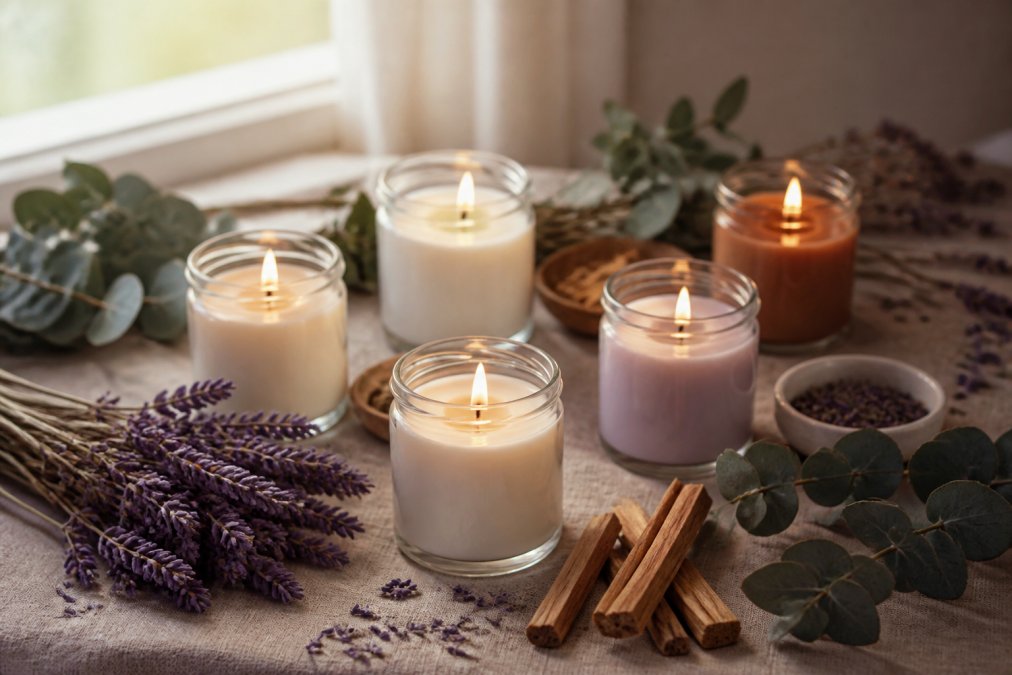
| Scent | Primary Effect | Best For | Fragrance Category |
|---|---|---|---|
| Lavender | Nervous system calming | Sleep, anxiety relief | Floral middle note |
| Sandalwood | Grounding, warmth | Meditation, deep focus | Earthy base note |
| Eucalyptus and Mint | Stress relief, mental clarity | Daytime wind-down | Herbal top note |
| Vanilla and Amber | Emotional comfort, coziness | Evening relaxation | Sweet base note |
| Chamomile | Gentle anxiety reduction | Anxious minds, light sleepers | Floral middle note |
| Cedarwood | Deep calm, earthy anchoring | Meditation, heavy stress | Woody base note |
| Bergamot | Mood lift without stimulation | Afternoon reset | Citrus top note |
1. Lavender: The Nervous System's Reset Button
Lavender is the most studied scent in aromatherapy research. Its primary active compounds, linalool and linalyl acetate, interact with GABA receptors in a way that reduces nervous system excitation, essentially the same pathway targeted by certain anti-anxiety medications, though at a far milder level. Lighting lavender in the hour before bed creates an environmental cue that signals your body to begin winding down. As noted in Johns Hopkins Medicine's overview of aromatherapy benefits, lavender is one of the few essential oils with consistent evidence for reducing anxiety and improving sleep quality.
Not all lavender candles are created equal. A candle using synthetic fragrance oil labeled "lavender" may smell similar but lacks the botanical compounds responsible for the therapeutic effect. Look for candles that specify natural lavender essential oil or high-quality botanical extracts in their scent composition.
Best for: Sleep hygiene routines, anxiety relief, evening self-care.
2. Sandalwood: Grounding and Warmth
Sandalwood stops a restless mind. Its dense, woody base note creates a sensory experience that many describe as feeling "anchored," which is exactly what grounding means in nervous system terms. When the mind cycles through anxious thoughts, heavy base notes give the olfactory system something stable to orient around. Sandalwood also pairs exceptionally well with other scents, making it a foundational note for scent layering.
Best for: Meditation, yoga, moments when anxiety is running high.
3. Eucalyptus and Mint: Stress Relief Without Sedation
Eucalyptus and mint activate cold receptors in the nasal passages, creating a sensation of openness and clarity that reduces the physical tension associated with stress without making you drowsy. Use these scents in the afternoon, during a work break, or to shift gears between tasks, they work against sleep hygiene and should be avoided in the evening.
Best for: Daytime stress relief, mental clarity, afternoon reset.
4. Vanilla and Amber: Cozy Emotional Regulation
Vanilla triggers associations with comfort and safety through learned experience and its similarity to certain human pheromones. Amber adds resinous warmth that extends the cozy atmosphere into something more sophisticated. This combination doesn't sedate or stimulate, it simply makes a space feel safe, which is often exactly what stress-depleted people need.
Best for: Evening relaxation, cozy atmosphere building, emotional comfort.
5. Chamomile: Gentle Calming for Anxious Minds
Chamomile is the quieter sibling of lavender. Its calming effects are real but gentler, making it a better choice for people who find lavender too strong or who have scent sensitivities. For people who've had headaches from strongly scented candles, chamomile is often a better entry point into aromatherapy candles.
Best for: Scent-sensitive individuals, light anxiety, gentle evening wind-down.
6. Cedarwood: Earthy Base Notes for Deep Calm
Cedarwood creates calm through something primal. The earthy, forest-like quality activates what researchers call "nature-relatedness," the documented psychological benefit of exposure to natural environments. Cedarwood is also one of the best scents for meditation because it doesn't carry strong emotional associations for most people, creating a neutral, grounded space rather than triggering distracting memories.
Best for: Meditation, deep stress, creating a neutral calming environment.
7. Bergamot: Citrus Lift That Still Calms
Bergamot is bright and mood-enhancing, but it doesn't have the energizing sharpness of lemon or orange. Its specific chemical profile, particularly its linalool content (shared with lavender), gives it a calming quality that other citrus scents lack. This makes bergamot one of the most versatile best candle scents for relaxation, working in the morning without overstimulating, in the afternoon as a stress reset, and in early evening as a gentle transition toward wind-down.
Best for: Mood regulation, versatile daily use, stress relief without sedation.
Scents for Sleep and Meditation: What to Burn and When
Timing matters as much as scent selection. For sleep, light your candle 30 to 60 minutes before bed and choose from the sedating end of the spectrum: lavender, chamomile, cedarwood, or vanilla and amber. Consistency builds a conditioned response over time, which is a genuine sleep hygiene strategy.
For meditation, you want a scent that promotes focus and presence without inducing drowsiness. Sandalwood and cedarwood are the strongest choices. Bergamot works well for shorter sessions. Avoid eucalyptus and mint during meditation since the mental clarity they create can make it harder to settle into stillness.
Scent Layering Techniques for a Deeper Sensory Experience
Scent layering is the practice of burning two complementary candles simultaneously to create a more complex, multi-dimensional fragrance environment. Pair a base note candle with a floral middle note candle to create depth. For example, cedarwood and chamomile together produce something earthier and more complex than either alone.
A few practical rules for layering:
- Keep both candles in the same room but space them at least a metre apart to prevent scent competition
- Light the base note candle first, allow it to warm for 10 minutes, then light the secondary candle
- Avoid layering more than two scents at once; complexity beyond two notes typically reads as confusion rather than richness
Best Non-Toxic Scented Candles: What to Look For
The best non-toxic scented candles share three characteristics: clean-burning wax, transparent fragrance sourcing, and a wick that doesn't introduce heavy metals into your air. According to the Environmental Protection Agency's guidance on indoor air quality, indoor air can be significantly more polluted than outdoor air, with candles being one of the contributing sources when made from lower-quality materials.
Wax Types and Their Environmental Impact
Paraffin wax is the most common and least expensive wax. It's a petroleum byproduct that can release volatile organic compounds when burned. Soy wax is plant-derived, renewable, and burns significantly cleaner than paraffin, with a longer burn time per ounce. Coconut wax is the premium option, burning cleaner than soy with an excellent scent throw and sustainable sourcing. Beeswax is natural and clean-burning but not vegan and more expensive than soy.
For most people seeking non-toxic scented candles, soy wax or coconut wax is the right choice. Hand-poured candles prioritize clean burn performance over mass-production shortcuts.
Scent Sensitivity, Allergies, and Fragrance Transparency
Scent sensitivity ranges from mild preference to genuine allergic reaction. The most common triggers are synthetic fragrance compounds, particularly certain phthalates used as fragrance fixatives in lower-quality candles. If you've had headaches from scented candles before, the issue is almost certainly synthetic fragrance, not fragrance itself.
What to look for on a label:
- Phthalate-free fragrance oil or essential oil-based scent
- Paraffin-free or soy/coconut wax base
- Cotton or wood wick (not metal-core wicks)
- Fragrance load percentage disclosed (8-12% is typical for strong throw)
- No added dyes if you're particularly sensitive
Candle Burn Time for Relaxation: Getting the Most From Every Candle
A few rules make a real difference in candle performance:
The first burn is the most important. Wax has memory. Burn it long enough for the melt pool to reach the edges of the jar, typically two to three hours for a standard jar candle, or you'll create a tunnel that wastes most of the wax.
Trim your wick before every burn. A wick longer than about 6 millimeters produces a larger flame that burns hotter and faster, reducing burn time and producing soot. A properly trimmed wick gives you a cleaner, slower burn with better scent throw.
Burn duration for relaxation sessions. For a 30-minute meditation or wind-down routine, a single burn session is enough to scent a medium room. Two to three hours is the practical sweet spot for longer relaxation periods.
Storage matters for scent retention. Keep candles away from direct sunlight and heat when not in use. UV exposure degrades fragrance compounds.
How to Create a Self-Care Sanctuary at Home
Creating a self-care sanctuary doesn't require a dedicated room or major renovation. The sensory experience of a space is largely shaped by light, scent, and texture.
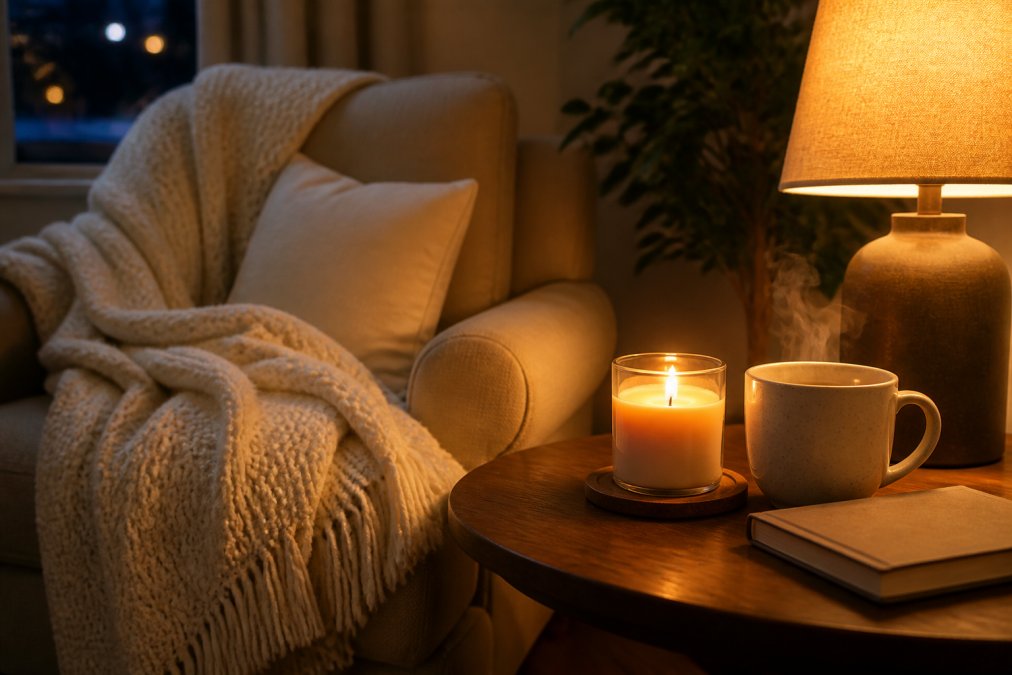
Start with ambient lighting. Overhead lighting keeps the nervous system in alert mode. A single lamp or cluster of candles creates the warm, low-contrast light environment that signals safety and rest. Scented candles do double duty here, contributing both fragrance and ambient lighting.
Scent anchors the space. Choose one signature relaxation scent for your sanctuary corner and use it consistently. Over time, the scent itself becomes a psychological trigger for relaxation, a conditioned response that works faster and more reliably the more you repeat it.
Texture completes the environment. A soft throw, a comfortable chair, a warm mug. These tactile elements work alongside scent and light to create a complete sensory experience that shifts your nervous system into parasympathetic mode, the rest-and-digest state, without requiring active effort.
As the American Psychological Association's guidance on stress management notes, creating intentional environmental cues for relaxation is a recognized strategy for managing chronic stress, and sensory rituals are among the most accessible tools available. The self-care sanctuary concept scales to any space, a studio apartment corner works as well as a dedicated room if the sensory elements are right.
Frequently Asked Questions
What candle scents are best for anxiety and stress?
Lavender, chamomile, and bergamot are consistently linked to calming effects on the nervous system. Lavender in particular has been studied for its ability to lower heart rate and cortisol levels. Sandalwood and cedarwood work well as grounding base notes when anxiety feels scattered rather than acute. For the strongest stress relief, look for candles that blend a floral top note with a warm, woody base, that combination tends to signal safety to the brain's olfactory system.
Do scented candles actually help with relaxation?
Yes, with some nuance. The olfactory system connects directly to the brain's limbic region, which governs emotion and memory. Certain fragrance notes, especially lavender, vanilla, and sandalwood, trigger measurable changes in mood and stress markers. The best candle scents for relaxation work partly through scent chemistry and partly through ritual: lighting a candle signals your brain that it's time to unwind. That behavioral cue alone has real value for emotional regulation and mindfulness practice.
Which candle scent is most calming for sleep?
Lavender is the most researched scent for sleep hygiene, with studies showing it can improve sleep quality and reduce nighttime waking. Chamomile and cedarwood are strong secondary choices. For meditation before bed, sandalwood's slow-burning base notes create a grounding atmosphere without stimulating the senses. Avoid citrus-heavy blends like bergamot or lemon at night, those top notes tend to sharpen alertness rather than ease you toward sleep.
Are there non-toxic candle options for relaxation?
Absolutely. The best non-toxic scented candles use soy wax or coconut wax instead of paraffin, which releases petroleum-based byproducts when burned. Look for candles that are paraffin-free, use cotton or wood wicks, and disclose whether their fragrance oils are phthalate-free. If you have scent sensitivity or allergies, prioritize candles with transparent ingredient lists. Hand-poured artisanal candles often offer more ingredient transparency than mass-produced options, making it easier to avoid known irritants.
How long should you burn a candle for maximum relaxation?
A 30-to-60-minute burn session is the sweet spot for most relaxation rituals. That's long enough to fill a room with scent throw and settle into a calm atmosphere, without over-saturating the space. For your first burn, let the wax melt to the edges of the jar, this prevents tunneling and ensures even burn time throughout the candle's life. Never burn a candle for more than four hours at a stretch, and always trim the wick to about a quarter inch before relighting.
Carbondale Candle hand-pours premium scented jar candles designed to enhance your home's ambience and support genuine relaxation. Whether you're building a nightly wind-down ritual or looking for a meaningful gift, explore the full collection and find your signature scent.
This article was written using GrandRanker