
Table of Contents
- What You'll Need to Test Candle Wax at Home
- How to Identify Quality Candle Wax by Touch and Look
- Soy vs Paraffin Wax Quality: What the Difference Actually Means
- Clean Burning Candle Wax Types and How to Spot Soot Problems
- The Home Burn Test: Melt Pool, Throw, and Tunneling Checks
- Spotting Additives, Stabilizers, and Sourcing Red Flags
- Why Artisan Candles Cost More (and When It's Worth It)
- Frequently Asked Questions
Last Updated: September 13, 2026
What You'll Need to Test Candle Wax at Home
You can identify quality candle wax at home with your senses and a few household items. Here are the tests we use at Carbondale Candle.
Gather these before you start:
- A clean, flat work surface with good lighting
- A small paring knife or craft blade for shaving a sliver of wax
- A kitchen scale accurate to 0.1 oz if you want to compare density
- A ruler or caliper for measuring the melt pool
- A timer for the burn test
- A notepad to record texture, scent, and burn behavior
The checks below move from quick to thorough: touch and sight first, then a full burn test. Most quality problems show up in the first two minutes.
How to Identify Quality Candle Wax by Touch and Look
Quality candle wax is smooth, evenly colored, and cool to the touch with a faint, clean scent rather than a chemical sharpness. Press your fingertip in: it should give slightly without feeling greasy or leaving residue. A well-made candle looks uniform across the top, with no cloudy patches, cracks, or pooled oil.
Reading Texture, Color, and Surface Cues
Rub a sliver between your fingers and note what you feel:
- Smooth and slightly waxy: typical of soy and soy blends, a good sign of even pouring
- Firm and dry, almost brittle: common with beeswax and high-paraffin blends
- Greasy or slick: often means excess fragrance oil or a poorly balanced blend
- Grainy or streaked: a sign of uneven cooling or a rushed pour
Color should be consistent from edge to center. Pale, cloudy blotches are usually frosting, a harmless cosmetic effect common in natural waxes, though heavy frosting can point to poor temperature control. Cracks or a sunken center suggest the wax cooled too fast.
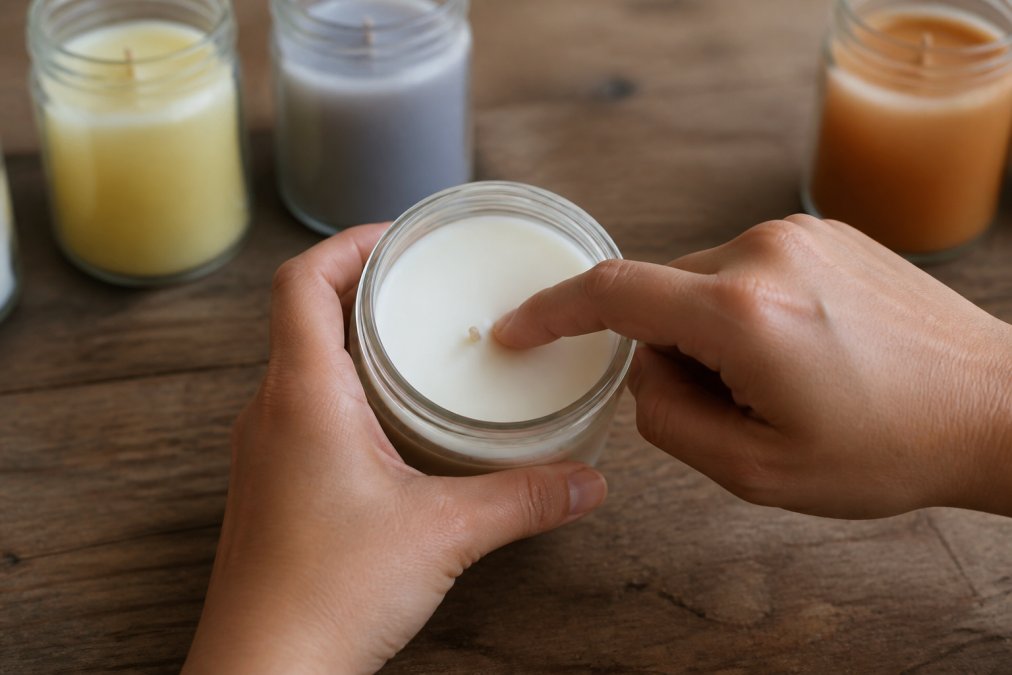
Container Wax vs. Pillar Wax: Why It Changes What You Feel
Container wax is soft and formulated to cling to glass, so it should feel pliable and slightly tacky. Pillar wax is harder and drier because it must stand on its own. A soft, oily pillar will slump; a rock-hard container candle may tunnel.
Soy vs Paraffin Wax Quality: What the Difference Actually Means
Soy wax is a vegetable-based wax made from soybean oil, while paraffin wax is petroleum-based and derived from refined crude oil. (PubMed) The difference is not "good" versus "bad", it comes down to burn behavior, scent performance, and heat handling.
Soy burns cooler and slower, with a smaller melt pool and softer cold throw. Paraffin has a higher melting point, stronger hot throw, and a brighter flame. Coconut wax sits between the two, prized for a clean, even burn.
| Wax Type | Feel | Scent Throw | Best For |
|---|---|---|---|
| Soy | Soft, smooth | Moderate | Slow, even burns |
| Paraffin | Firm, dry | Strong | Maximum scent |
| Beeswax | Hard, slightly tacky | Mild, natural | Long, clean burns |
| Coconut blend | Creamy, soft | Moderate to strong | Even melt pools |
A high-quality version of any wax here burns evenly and holds its scent; a low-quality one smells faint or chemical and burns unevenly.
Clean Burning Candle Wax Types and How to Spot Soot Problems
Clean burning candle wax types are those that produce a steady flame with little to no visible soot, minimal smoke, and no blackening around the jar rim. Soy, beeswax, and coconut blends generally burn cleaner than straight paraffin, though a well-made paraffin candle can too.
Watch for these soot signals during and after a burn:
- Black smoke curling from the flame
- A dark ring forming on the glass or a soot smudge on the ceiling above
- A flame that flickers wildly or grows tall and sooty
- A wick that mushrooms or needs constant trimming
Soot usually points to an oversized wick, too high a fragrance load, or synthetic additives that do not burn cleanly, signs of a poorly balanced candle, in every wax type.
The Home Burn Test: Melt Pool, Throw, and Tunneling Checks
A quality candle forms a full melt pool edge to edge within about one hour per inch of diameter, throws scent evenly through the room, and never tunnels. (cpsc.gov) This is the most reliable home test, and it takes one burn session.
Set Up the Test Properly
Setup choices change your results more than the wax itself:
- Burn in a room with still air. A ceiling fan, HVAC vent, or open window skews the melt pool shape.
- Keep the room between roughly 65°F and 75°F. Cold rooms cause tunneling unrelated to wax quality; hot rooms make wax pool faster than the wick can keep up.
- Trim the wick to about 1/4 inch before every burn. An untrimmed wick is the number one cause of a falsely "bad" result.
- Set the candle on a heat-safe surface, not directly on finished wood.
Run the Burn in Timed Intervals
- Light the candle and start your timer.
- At 30 minutes, measure the melt pool across its widest point. Write it down.
- At one hour, measure again. A correctly burning candle adds roughly 1/4 to 1/2 inch of pool diameter per hour, depending on wick size and wax type.
- Continue until the pool reaches the container edge, or until you have burned one hour per inch of container diameter, whichever comes first.
- Blow it out, never water or a lid, which distorts the surface you need to inspect.
- Let it cool completely, then look at the top. A clean, level surface means even cooling; a sunken center with a ring of unmelted wax is tunneling.
Read the Results Like a Diagnostician
The melt pool shape tells you what went wrong:
- Full pool, even edge to edge, level surface: wax, wick, and scent load are balanced.
- Pool reaches the edge but the surface is cratered: burned too hot, usually from an oversized wick or heavy fragrance load. The wax is fine; the build is not.
- Pool stops short of the edge and tunnels down the center: the wick is undersized, or the wax melting point is too high for the wick. This is the most common defect in mass-produced jar candles.
- Pool is lopsided, deeper on one side: the wick is off-center, a pouring defect that wastes wax and shortens burn time.
- Pool forms fast, then the flame grows tall and smokes: too much fragrance oil or an additive not burning cleanly.
Measure Scent Throw, Not Just Scent Presence
Hot throw is subjective, but you can make it comparable:
- Step out of the room for five minutes, then walk back in. The scent on re-entry is the true room-filling throw.
- Note how far away you can still detect the scent. A strong throw reaches across a living room; a weak one stays within a few feet.
- Note whether the scent changes as it burns. A candle that smells pleasant cold but turns sharp when lit is usually over-fragranced or built on a low-grade base wax.
The Weight-Loss Check
A kitchen scale accurate to 0.1 oz turns the burn test into a measurement.
- Weigh the candle before lighting. Record the number.
- Burn for exactly one hour per inch of diameter, then extinguish and let it cool completely.
- Weigh it again. The difference is the wax consumed during that burn.
- Compare that number to the stated burn time. If the label claims 40 hours but the weight loss implies 25, the burn time is inflated or the wick is running hot.
Fast weight loss means the candle is burning hot, usually too large a wick or too much fragrance oil. Slow, steady loss points to a well-balanced pour.
What the Burn Test Cannot Tell You
The burn test reveals how a candle performs, not what is in it. A candle can burn cleanly and still be built on a cheap paraffin base with heavy synthetic additives. To find out what is in the wax, use the label-reading and additive checks below.
Spotting Additives, Stabilizers, and Sourcing Red Flags
Additives like stearic acid, UV inhibitors, and synthetic fragrance boosters are common in commercial wax, and they are not automatically bad, but undisclosed heavy use often masks a low-quality base wax. (PubMed) Stearic acid hardens soft wax and improves mold release. UV inhibitors slow the yellowing sunlight causes in paraffin. Synthetic additives can prop up a weak scent throw. The problem is not their presence, it is what they hide.
Physical Clues That Point to Additives
You cannot isolate a single additive with kitchen tools, but you can spot the patterns heavy use leaves behind:
- Stearic acid: Common in pillar and votive wax for hardness. Heavy stearic content feels dry and chalky rather than waxy, leaves a faint white powder on your fingers, and looks cloudy in what should be a translucent wax.
- UV inhibitors: Invisible, but their absence shows as yellowing. A white paraffin candle turned yellow after months near a window either lacked a UV inhibitor or used too little. Cosmetic, not a safety issue, but it signals a maker who did not formulate for shelf life.
- Scent boosters and synthetic fixatives: Hardest to detect directly. The tell is a scent that smells strong and sharp when cold, then turns flat or acrid when burned. A well-formulated candle smells softer cold and fuller when lit; one that peaks before lighting is leaning on boosters.
- Excess fragrance oil: Rub a sliver between your fingers. If it feels greasy rather than waxy, the fragrance load is likely above what the wax can hold. Overloaded wax sweats oil, pools unevenly, and burns hot.
Read the Label Like a Formulator
Labels are the fastest source of additive information, if you know what to look for:
- "Premium blend" or "proprietary wax blend" with no detail: a red flag. Every quality maker can name the base wax, even if the ratio is proprietary.
- "Soy blend" with no percentage: blends range from mostly soy to mostly paraffin. A maker who will not give a rough ratio is usually hiding a low soy content.
- "Fragrance" with no qualifier: ask whether it is phthalate-free. A maker who cannot answer is not tracking their supply chain.
- "Natural" with no ingredient list: treat as unverified. Natural is a marketing term, not a regulated one for candles.
- No wick type listed: wick type (cotton, cotton-paper core, wood, zinc core) matters for burn quality. A maker who does not disclose it is usually not testing it.
Use the Safety Data Sheet as a Verification Tool
For any wax you buy in bulk or any maker willing to share, the Safety Data Sheet (SDS) is the most useful document for verifying what is actually in the wax. Manufacturers must provide one, and it lists chemical composition, melting point range, flash point, and hazardous components.
What to look for:
- Melting point range: a narrow range (for example, 125°F to 130°F) indicates a tightly specified wax. A wide range suggests a blend of unknown proportions.
- Composition section: pure soy, beeswax, and paraffin list a single primary component. A long list of trade-named ingredients signals heavy additive use.
- Flash point: useful for safe handling and a rough indicator of behavior under heat.
Ask the maker or supplier for the SDS by name. A maker who can produce it quickly is almost always working with better materials.
Sourcing Questions That Separate Makers
Ask these when buying, and note how easily the answers come:
- Does the maker name the wax type and origin, or only say "premium blend"?
- Is the scent listed as essential oil, phthalate-free fragrance, or simply "fragrance"?
- Does the label disclose additives, or stay vague?
- Can the seller tell you the pour temperature or melting point?
- Can they produce an SDS on request?
Sourcing transparency is the clearest quality signal there is. A maker who can name their wax supplier, wick type, and scent load is almost always working with better materials. Vague labels usually mean vague ingredients.
Why Artisan Candles Cost More (and When It's Worth It)
Artisan candles cost more because small-batch makers spend more on better wax, higher scent loads, and slower, more careful pouring, not because of marketing. A hand-poured candle is made in small runs where the maker controls pour temperature, wick centering, and container adhesion in ways a production line cannot.
That control shows up in the burn: even melt pools, consistent scent throw, and clean jar rims come from a maker who tests each batch. Mass-produced candles optimize for speed and shelf life, often meaning less wax quality and a weaker throw.
When is the higher cost worth it? When you care how the candle performs:
- You want a scent that fills a room, not just the top of the jar
- You want an even burn with no tunneling or wasted wax
- You want to know what is in the candle, especially if scents have bothered you before
- You are buying a gift and want it to feel considered
At Carbondale Candle, we hand-pour in small batches to control exactly these variables, the practical difference between a candle that looks good in a photo and one that performs.
Judging a candle before you buy online is genuinely hard, you cannot press the wax through a screen or smell the cold throw from a photo. The fix is to buy from a maker who controls the variables that matter: wax quality, wick sizing, scent load, and pour temperature. Carbondale Candle hand-pours premium scented jar candles, wax melts, and personalized novelty options in small batches, so each one is built to pool evenly and throw scent the way it should. Get lit with us and see what a properly made candle burns like.
Frequently Asked Questions
Which candle wax should you avoid?
Wax that crumbles, feels greasy, or smells harsh before lighting often signals heavy synthetic additives or poor refining. Paraffin blends with visible soot rings after a short burn are another warning sign. Skip candles with no wax type listed, uneven color, or a wick that leans hard to one side. If the cold throw smells chemical rather than true to the scent name, that batch likely cut corners on quality.
How can you tell if a candle is high quality just by looking at the wax?
Look for smooth, even color with no cloudy patches or white frost unless it's pure soy, where frosting is normal. The wax should sit flush against the glass with no air gaps or shrinkage cracks. A centered, well-trimmed wick and a clean, dry top surface are good signs. Streaks, mottling, or pooled oil on top suggest a rushed pour or too much fragrance oil.
How does wax type affect the scent throw of a candle?
Paraffin typically delivers a stronger hot throw at lower scent loads, which is why some mass-market candles smell bold. Soy and coconut wax blends usually need a higher scent load and a proper cure time to match that intensity, but they burn cooler and cleaner. Beeswax throws gently on its own and blends well with other waxes. The real test is hot throw within 30 minutes of lighting.
Is there a difference between paraffin and natural waxes in terms of quality?
Yes, but not in the simple way most people assume. Quality depends on refining, scent load, wick matching, and pour technique more than the base wax alone. A well-made paraffin candle can burn cleanly with minimal soot, while a poorly made soy candle can tunnel and smoke. Natural waxes like soy, coconut, and beeswax come from vegetable or animal sources and often appeal to buyers wanting a lower carbon footprint.