
Table of Contents
- Why Artisan Candles Cost More: The Short Answer
- The Benefits of Soy Wax Candles and Other Natural Waxes
- Hand Poured vs Machine Made Candles: What Changes on the Line
- Candle Burn Time Comparison: Cost per Hour, Not Cost per Jar
- Fragrance Load, Scent Throw, and Why Cheap Candles Smell Weak
- The Costs You Never See: Testing, R&D, and Packaging
- What Artisan Candles Cost at Carbondale Candle
- Frequently Asked Questions
Last Updated: September 16, 2026
Why Artisan Candles Cost More: The Short Answer
Artisan candles cost more because almost every step that determines how a candle looks, smells, and burns is done by hand in small batches rather than on an automated line. According to the U.S. Small Business Administration's guide to manufacturing costs, small producers carry higher per-unit costs for materials, labor, and compliance than large-scale manufacturers. At Carbondale Candle, we hand-pour every jar in small runs, which means one person touches each candle instead of a machine stamping out thousands per hour. That labor shows up in the price tag, but it also shows up in how the candle performs.
The gap between a mass-market candle and a hand-poured one usually comes down to five cost drivers: the wax, the fragrance load, the wick, the testing, and the packaging. None of them are glamorous. Together, they explain most of the price difference you see on the shelf.
The Benefits of Soy Wax Candles and Other Natural Waxes
Natural waxes cost more per pound than paraffin, and that premium is the first place artisan pricing starts to diverge. The reason is chemistry, not marketing. Paraffin is a petroleum byproduct refined from crude oil; soy wax is hydrogenated soybean oil, coconut wax is hydrogenated coconut oil, and beeswax is secreted by honeybees. Each of those feedstocks carries a different refining cost, and paraffin is almost always the cheapest because it is a high-volume refinery byproduct rather than a purpose-grown agricultural oil.
That cost gap shows up in how the candle burns. Paraffin has a higher melting point and a denser molecular structure, so it tends to burn hotter and faster. Soy and coconut waxes have lower melting points, which produces a cooler, slower melt pool and, in practice, a longer burn per ounce of wax. Beeswax has the highest melting point of the natural options and burns the longest of the three, which is why it is often blended in small percentages rather than used alone.
Here is how the four common waxes compare on the variables that actually drive price and performance:
| Wax | Source | Relative cost per lb | Melt behavior | Typical burn character |
|---|---|---|---|---|
| Paraffin | Petroleum byproduct | Lowest | Higher melt point | Hot, fast, can soot |
| Soy | Hydrogenated soybean oil | Moderate | Lower melt point | Cool, even, slower |
| Coconut | Hydrogenated coconut oil | Moderate to high | Low melt point | Smooth melt pool, blends well |
| Beeswax | Honeybee secretion | Highest | Highest melt point | Firm, long burn, natural aroma |
The benefits of soy wax candles go beyond the label. Because soy burns cooler, the fragrance oil in the wax is released more gradually, which many makers find produces a more even hot throw over the life of the candle. Coconut wax blends well with soy because its lower melt point helps the two waxes marry into a smooth, creamy melt pool without the frosting and cracking that pure soy can develop. Beeswax brings a naturally firm texture and a faint honey note that some buyers specifically seek out.
There is also a safety and air-quality dimension that cheap paraffin candles often ignore. Paraffin is a petroleum-derived wax, and when it burns it can release the same kinds of ultrafine particles and volatile organic compounds associated with other combustion sources. Natural waxes are not combustion-free, but they generally produce less soot and fewer of those petroleum-derived byproducts. That difference is one of the concrete reasons a natural-wax candle can justify a higher price: you are paying for a cleaner burn, not just a prettier label.
Many artisan makers also choose phthalate-free fragrance oils and, in some cases, essential oils, adding another layer of cost. Phthalates are plasticizers sometimes used in fragrance formulations; phthalate-free oils cost more because the fragrance house has to reformulate without them. Essential oils cost dramatically more per ounce than synthetic fragrance and are often used at low percentages to add a top note rather than to carry the whole scent.
- Soy wax: plant-based, slower burn, good scent throw, prone to frosting
- Coconut wax: smooth melt pool, blends well with soy, low melt point
- Beeswax: firm, naturally sweet aroma, longest burn, highest cost
- Paraffin wax: cheapest, but often burns hotter and faster with more soot
The trade-off is simple. You pay more per candle, but you get a cleaner burn and a wax that behaves predictably in the jar. The per-pound premium on natural wax is real, and it is the first line item that separates an artisan price from a mass-market one.
Hand Poured vs Machine Made Candles: What Changes on the Line
The difference between hand poured vs machine made candles is control.
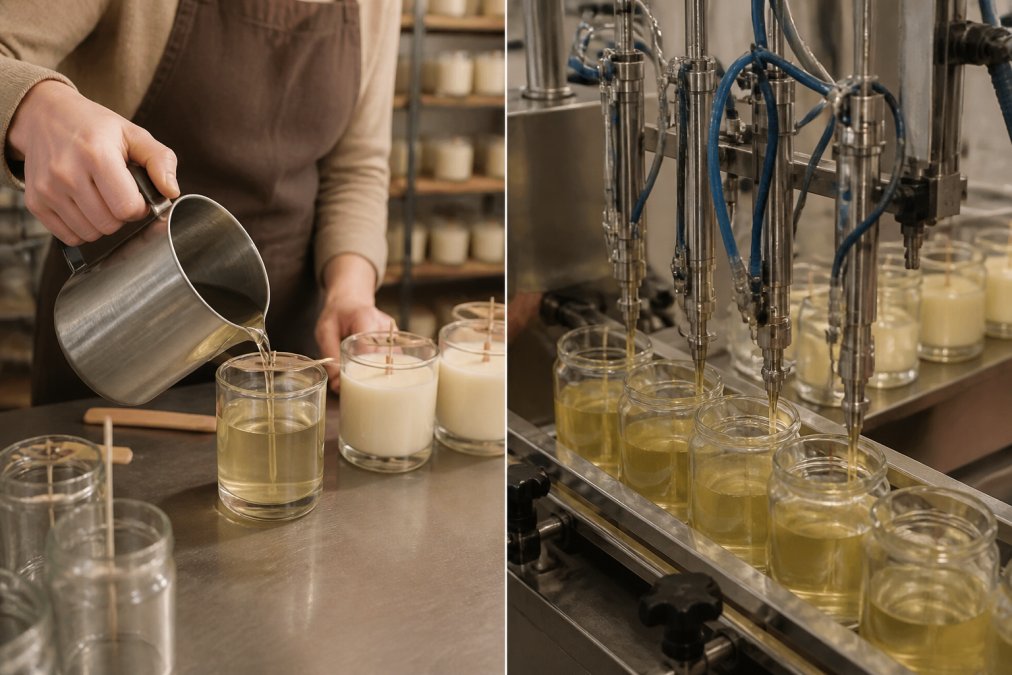
Machine-made candles win on consistency and cost. Hand-poured candles win on the details that a machine can't check.
Candle Burn Time Comparison: Cost per Hour, Not Cost per Jar
A candle burn time comparison usually reveals that the cheaper jar isn't actually cheaper. A larger, well-made candle with proper wick sizing and a quality wax can burn for many more hours than a small mass-produced one, which lowers the cost per hour of use even when the sticker price is higher.
Here's how to think about it:
| Factor | Mass-Market Candle | Artisan Hand-Poured Candle |
|---|---|---|
| Wax type | Often paraffin | Soy, coconut, or beeswax |
| Wick sizing | Fixed for the whole run | Adjusted per batch |
| Burn behavior | Can tunnel or burn hot | Even melt pool when wicked right |
| Cost per jar | Lower | Higher |
| Cost per hour | Often higher over time | Often lower over time |
Fragrance Load, Scent Throw, and Why Cheap Candles Smell Weak
Fragrance load is the percentage of scent oil mixed into the wax, and it's the biggest reason cheap candles smell weak. Mass producers often keep fragrance load low to cut costs. Artisan makers push it higher, which costs more per candle but produces a stronger hot throw and cold throw.
- Cold throw: how strongly the candle smells before it's lit
- Hot throw: how strongly it smells while burning
- Fragrance load: how much scent oil is in the wax
- Scent complexity: how many notes are layered into the blend
The Costs You Never See: Testing, R&D, and Packaging
Testing and R&D are the hidden costs that never show up on a candle's label, but they're baked into every artisan price. This is the section most competitors skip, because the work is invisible and the numbers are unglamorous. Here is what actually happens before a single candle is sold.
- Candle testing across multiple burn cycles
- Wick sizing trials for each jar size and scent
- Melt pool measurement at timed intervals
- Fragrance load adjustments and retesting
- Vessel quality, thermal shock, and lid fit
- Sustainable packaging and shipping protection
What Artisan Candles Cost at Carbondale Candle
Pricing at Carbondale Candle reflects exactly the costs above: small-batch pouring, quality wax, real fragrance load, and packaging that protects the jar. Here's what that looks like across our range.
| Product | Size | Price |
|---|---|---|
| 10oz Frosted Black Jar Candle, Scented | 10oz | $14.99 |
| PERSONALIZE MY CANDLE | 10oz | $19.99 |
| Memorial Candles | 10oz | $19.99 |
| Clear Jar 15oz | 15oz | $19.99 |
| Anytime Special 90oz, 3 wick, Custom Candle | 90oz | $99.99 |
Frequently Asked Questions
Why have candles gotten so expensive?
Raw material costs drive most of it. Natural waxes like soy, coconut, and beeswax cost more per pound than paraffin, and quality fragrance oils run higher too. Add hand-pouring labor, wick testing, and packaging, and a small-batch maker carries costs a mass manufacturer spreads across millions of units. A 10oz hand-poured jar often lands between $15 and $25, while a comparable mass-market jar can sell for under $10.


Are expensive candles actually better quality?
Not automatically, but price usually tracks specific differences you can check. Look for a stated wax type, a quality fragrance load, a cotton or wood wick sized to the jar diameter, and a listed burn time. Artisan candles from small-batch makers tend to include those details because each batch is tested. A high price with no ingredient or burn-time info is a warning sign, not a guarantee.
What ingredients make artisan candles more expensive?
Four things: the wax, the fragrance, the wick, and the vessel. Soy wax, coconut wax, and beeswax cost more per pound than paraffin. Phthalate-free fragrance oils and essential oils cost more than basic synthetic blends. Properly sized wicks, often cotton or wood, require testing per jar size. Thicker glass vessels and sustainable packaging add cost too.
How does the candle-making process affect the final price?
Hand-poured candles are made in small batches, so labor is a real line item. Each batch needs wax melted to a specific temperature, fragrance blended in, wax poured and cooled slowly to avoid cracks, wicks trimmed, and jars labeled. A machine line can pour thousands of jars per hour with consistent results. A small shop might pour 50 to 100 jars in a day, and that time is built into the price.
The real challenge with artisan candles is that you can't smell them before you buy, and that's exactly why the ingredients and the process matter so much. Carbondale Candle hand-pours every scented jar candle, wax melt, and novelty piece in small batches, offers personalized and memorial candles you can customize with your own image or message, and builds each one around quality wax and real fragrance load. Get lit with us and find a candle that earns its price the moment you strike the match.