
Table of Contents
- What Makes a Candle Non-Toxic?
- Clean Burning Candle Ingredients to Look For
- Paraffin vs Soy vs Beeswax Candles: What's the Difference?
- Why Phthalate-Free Scented Candles Matter for Indoor Air Quality
- Best Non Toxic Scented Candles: Our Top Picks
- How to Identify a Truly Non-Toxic Candle
- Conclusion
- Frequently Asked Questions
Last Updated: September 11, 2026
What Makes a Candle Non-Toxic?
A non-toxic candle is made from a natural wax base, scented with phthalate-free fragrance or essential oils, and fitted with a lead-free wick that produces minimal soot. The best non toxic scented candles combine all three, and at Carbondale Candle we hand-pour every jar with that full picture in mind.
A candle burns for hours in a closed room, so whatever is in the wax ends up in the air your household breathes. Below, we'll break down which ingredients to avoid, how the main wax types compare, and which jars are worth your money in 2026.
Clean Burning Candle Ingredients to Look For
Clean burning candle ingredients come down to three components: a natural wax (soy, coconut, beeswax, or a blend), a cotton or wood wick with no metal core, and fragrance that is essential-oil-based or explicitly phthalate-free. If a label names all three, you have a transparent product; if it hides behind "proprietary fragrance blend," assume the worst.
What most guides miss is that the wick matters as much as the wax. A lead-core wick in an otherwise perfect soy candle still releases metal particulates into the air (cpsc.gov). The Consumer Product Safety Commission ban on lead-cored wicks closed that loophole years ago, but imported candles still occasionally slip through, so check the wick yourself.
- Natural wax base: soy, coconut, beeswax, or a blend of these
- Cotton or wood wick: no metal core, no zinc
- Phthalate-free fragrance: listed by name, not hidden
- No paraffin, no synthetic dyes: these drive soot and VOC emissions
- Reusable or recyclable vessel: glass jars you can repurpose
Paraffin vs Soy vs Beeswax Candles: What's the Difference?
The difference between paraffin vs soy vs beeswax candles is the wax itself, and it changes burn time, scent throw, soot output, and price. Paraffin is a petroleum byproduct: cheap, strong-smelling, and the biggest soot producer. Soy and coconut waxes are vegetable-based, burn cleaner, and hold scent well. Beeswax burns cleanest, with a faint honey note.
| Wax Type | Source | Soot Level | Scent Throw | Relative Cost |
|---|---|---|---|---|
| Paraffin | Petroleum byproduct | Highest | Strong | Lowest |
| Soy | Soybean oil | Low | Moderate to strong | Moderate |
| Coconut | Coconut oil | Low | Strong | Higher |
| Beeswax | Honeycomb | Lowest | Subtle | Highest |
| Blends | Soy + coconut or paraffin | Varies | Strong | Moderate |
Blends are where most of the market lives, and a soy-coconut blend often outperforms either wax alone on scent throw. The problem is a "soy blend" that's mostly paraffin with a splash of soy for the label.
Why Phthalate-Free Scented Candles Matter for Indoor Air Quality
Phthalate-free scented candles matter because phthalates are the plasticizers used to stretch fragrance oil and make it linger, and they are among the volatile organic compounds (VOCs) that off-gas when a candle burns (the EPA). For anyone who gets headaches, sneezes, or a scratchy throat around scented candles, fragrance is usually the first suspect.
Fragrance oils are concentrated aroma chemicals dissolved in a carrier, and phthalates, most commonly diethyl phthalate (DEP), have historically served as that carrier because they are cheap, stable, and slow the scent from flashing off too fast. When the candle burns, the fragrance and its carrier volatilize into the air. The concern is not a single acute exposure but repeated, cumulative exposure in a small, poorly ventilated room.
Under federal law, fragrance is treated as a trade secret, so a candle label can legally list "fragrance" or "parfum" as one catch-all term and disclose nothing about what is inside it. That means "phthalate-free" is a voluntary claim, not a regulated one: no agency certifies it and no standard defines it. The only real signal is a brand that names its fragrance source, states that it is essential-oil-based or phthalate-free by formulation, and publishes a readable ingredient list.
If you want to verify rather than trust, look for these signals in order of strength:
- A full ingredient list that names the wax, the wick, and the fragrance source, not just a marketing phrase.
- An explicit "phthalate-free" statement paired with a named fragrance type (essential oil blend, phthalate-free fragrance oil).
- Third-party testing or certification, which is rare for small hand-poured brands but is the strongest evidence when present.
- A batch or lot number, which indicates the brand tracks what went into each pour.
Treat a label that says "clean," "natural," or "non-toxic" with no ingredient disclosure as a red flag. Those words have no legal definition in candle labeling, so they cost the brand nothing to print and tell you nothing about what is in the jar.
Best Non Toxic Scented Candles: Our Top Picks
The best non toxic scented candles balance clean ingredients with a strong, honest scent throw and a fair price. Every pick below is hand-poured, paraffin-free, and built around a cotton or wood wick.
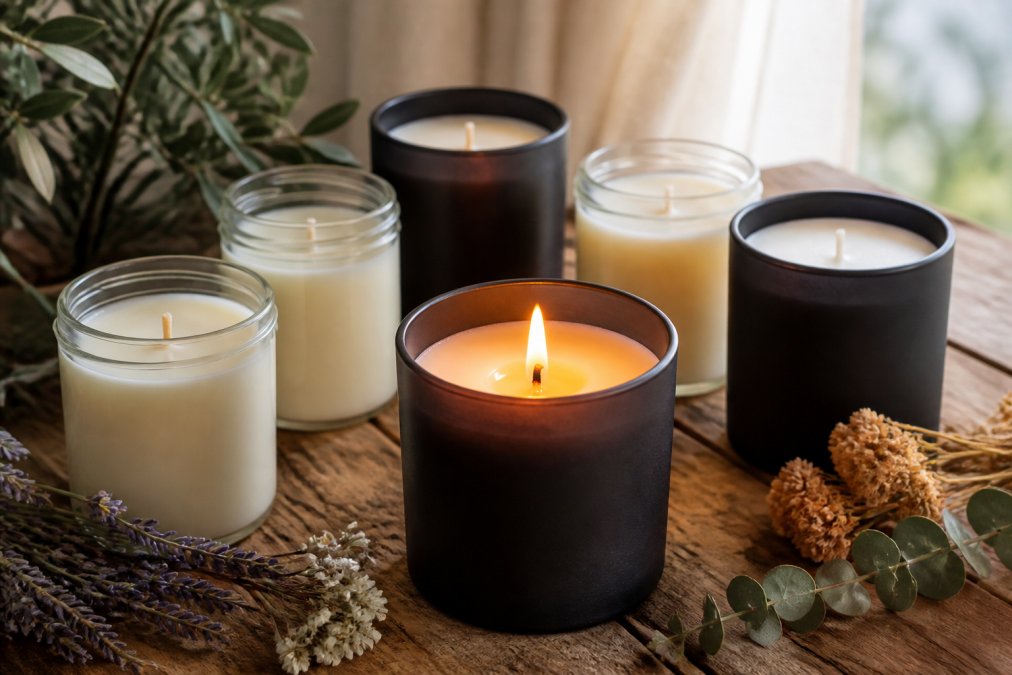
10oz Frosted Black Jar Candle, Scented
Our top pick, and a great choice for a first-time buyer. The frosted black jar hides wax discoloration between burns, and the wood wick crackles softly while producing a clean, even burn pool. It's double-scented, so the hot throw fills a living room. At $14.99, it offers a great value. The one drawback: the dark glass makes it harder to see how much wax is left.
Best for: Living rooms and anyone who wants a statement jar that still burns clean.
10oz Frosted Jar Candle, Scented
Same clean build, lighter look. The frosted clear jar lets you watch the wax level, and scent throw is consistent from first burn to last with a cotton wick that keeps soot to a minimum. This jar's wider melt pool helps it burn evenly to the edge.
Best for: Gifting, and anyone who wants to see the wax level at a glance.
Clear Jar 10oz and 15oz
The workhorse options. The 10oz Clear Jar runs $14.99 and the 15oz runs $19.99, a straightforward size upgrade if you burn candles nightly. The 15oz is a great option for a large open-plan space where smaller jars might get overwhelmed. Nothing fancy, just a reliable everyday candle.

Best for: High-traffic rooms and households that burn through candles fast.
Memorial Candles and Personalized Options
This is where Carbondale Candle does something most clean-candle brands don't. The Memorial Candles ($19.99) come scented or unscented and are customizable in every way: any idea, picture, or saying you want. The PERSONALIZE MY CANDLE option ($19.99) turns pictures, words, or coloring-book-style drawings into a 10oz scented image candle. For a birthday, graduation, or a way to honor someone, it makes a thoughtful gift.
Best for: Thoughtful gifts, memorial tributes, and milestones.
Seasonal Scents: Apple Cinnamon and Cinnamon Bun
Both $14.99, both 10oz, both built on the same clean wax base. Apple Cinnamon leans crisp and fruity; Cinnamon Bun is warm and bakery-sweet. If you're sensitive to strong fragrance, Apple Cinnamon is a great choice.
Best for: Fall and winter ambience, kitchens, and holiday gifting.
How to Identify a Truly Non-Toxic Candle
Identifying a truly non-toxic candle takes about thirty seconds. Flip the jar over, read the wax and wick disclosure, and look for a named fragrance source. If any of those three is missing, walk away. But label reading only tells you what is in the candle, not whether it is worth its price.
Label Transparency and Certification
Look for a full ingredient list, not a marketing claim. "Made with soy" means nothing; "100% soy wax, cotton wick, phthalate-free fragrance" means something. Third-party certifications help, but most small hand-poured brands skip them because of cost, so disclosure is the better signal.
Run the label through this quick filter:
- Wax named specifically: "soy," "coconut," "beeswax," or a named blend. Vague terms like "vegetable wax" or "natural wax blend" are a pass.
- Wick named specifically: cotton, wood, or paper. Any mention of a metal core, zinc, or lead is an automatic no.
- Fragrance source disclosed: essential oils, phthalate-free fragrance oil, or a named blend. "Fragrance" alone is a fail.
- Dyes and additives: none, or explicitly plant-based. Synthetic dyes add nothing to burn quality and can add to soot.
- Vessel: reusable glass or a refillable format. This matters for the next section.
Cost-Per-Hour: The Real Value of a Cleaner Candle
Cost-per-hour is the metric nobody publishes, and it is the one that tells you whether a candle is expensive. Divide the price by the burn hours. A $14.99 jar that burns for 40 hours costs about 37 cents per hour. A cheap $6 paraffin candle that burns 20 hours and tunnels halfway down costs 30 cents per hour but delivers half the usable light and far more soot. The clean candle usually wins, because a candle that tunnels is throwing away wax you already paid for.
Here is how to estimate burn hours before you buy, using the standard rule of thumb that a well-made candle burns roughly 7 to 9 hours per ounce of wax:
| Jar Size | Estimated Burn Hours | Example Price | Cost Per Hour |
|---|---|---|---|
| 10 oz | 70-90 hours | $14.99 | ~17-21 cents |
| 15 oz | 105-135 hours | $19.99 | ~15-19 cents |
| 6 oz paraffin | 30-40 hours | $6.00 | ~15-20 cents, plus soot |
The math shows that the larger clean jar can be a cost-effective option per hour of usable burn. The cheap paraffin candle may appear to be a bargain until you account for potential wax waste and soot.
The Two Tests That Separate a Good Candle From a Bad One
Label reading and cost math get you to the shortlist. Two physical tests tell you whether the candle was made well:
- The first-burn test. Light the candle and let it burn for two to three hours. A well-made candle forms a full melt pool that reaches the edge of the jar within that window. If it tunnels after that, the wick is undersized for the jar, and no amount of trimming will fix it.
- The wick-trim test. Before every relight, trim the wick to about 1/4 inch. A properly sized wick will burn steadily and self-trim as it goes. A wick that mushrooms, smokes, or flickers constantly is either the wrong size or the wrong material for the wax.
What to Do With the Jar When It Is Done
A clean candle should not end at the last burn. Once the wax is spent, freeze the jar for an hour, then pop the remaining wax out with a butter knife. Wash the glass with warm soapy water and you have a reusable vessel for pens, cotton balls, or a refill candle. A candle you can refill or repurpose keeps glass out of the waste stream and gives you a reason to buy from the same maker again.
Conclusion
Finding candles that burn clean without sacrificing scent throw is harder than it should be, because the industry has no agreed definition of non-toxic and no labeling standard to enforce one. That gap is why we hand-pour every jar at Carbondale Candle with a natural wax base, a cotton or wood wick, and disclosed phthalate-free fragrance, so you can read the label and know what you're breathing. From the $14.99 Frosted Black Jar to the fully customizable Memorial Candles at $19.99, each one is made to burn evenly, smell genuine, and look good on the shelf. Get Lit With Us and bring home a candle you don't have to second-guess.

Frequently Asked Questions
Are there any 100% non-toxic candles available?
No candle is completely chemical-free because all combustion produces some byproducts. However, the best non toxic scented candles use clean burning candle ingredients like beeswax or soy wax with cotton or wood wicks and phthalate-free fragrance oils. These produce significantly less soot and fewer volatile organic compounds than paraffin candles with synthetic fragrance. Look for paraffin-free, phthalate-free, and lead-free wick labels to get as close to non-toxic as possible.
What ingredients should I avoid in scented candles?
Avoid paraffin wax, which releases soot and volatile organic compounds when burned. Skip candles made with synthetic fragrance oils containing phthalates, as these can trigger headaches and respiratory irritation. Also avoid lead-core wicks, though these were banned in the US decades ago, and any candle that lists vague terms like 'fragrance' without specifying phthalate-free status. Choose candles with essential oil-based scents, cotton or wood wicks, and natural waxes instead.
Do non-toxic candles provide a strong scent throw?
Yes, when made well. Scent throw depends on fragrance load and wax quality, not on whether the candle is toxic. Phthalate-free scented candles with a high-quality natural wax blend can deliver excellent cold throw and hot throw. Carbondale Candle's 10oz scented jar candles, for example, are double-scented and hand-poured for consistent fragrance release. The key is choosing a maker that prioritizes quality ingredients.
How can I tell if a candle is truly non-toxic?
Check the label for specific claims: paraffin-free, phthalate-free, lead-free wicks, and natural wax. Look for essential oil-based or synthetic fragrance that is explicitly phthalate-free. A clean-burning candle should produce minimal soot and a steady flame without black smoke. If a brand won't disclose its wax type or fragrance ingredients, that's a red flag. Transparency about sourcing and ingredients is the strongest signal of a genuinely non-toxic candle.
Are soy candles considered non-toxic?
Soy candles are generally considered a better option than paraffin because soy wax is biodegradable, burns cooler, and produces less soot. However, soy alone doesn't guarantee non-toxic. The fragrance oils and wick material matter just as much. A soy candle with synthetic phthalate-laden fragrance and a lead wick is still problematic. Look for soy or soy-beeswax blends paired with phthalate-free scents and cotton or wood wicks for the cleanest burn.