
Table of Contents
- Why Small Rooms Need Different Candle Safety Rules
- Choose Non Toxic Candles for Home Use
- Set Up Your Candle on a Fire-Safe Surface
- How to Prevent Candle Soot Buildup
- Manage Ventilation and Air Currents
- Follow Candle Burn Time Guidelines
- Monitor Air Quality and Know When to Stop
- Conclusion
- Frequently Asked Questions
Last Updated: September 20, 2026
Why Small Rooms Need Different Candle Safety Rules
Small rooms create unique challenges when burning candles. Oxygen depletes faster, air quality suffers, and a candle that burns safely in a spacious living room can become a hazard in a bedroom or bathroom.
The good news: learning how to safely burn candles in small rooms is entirely possible. You just need to follow different rules than you would elsewhere.
Small rooms demand attention to ventilation, burn time, wick length, and candle placement. Get these right, and your small space becomes cozy and inviting without risk.
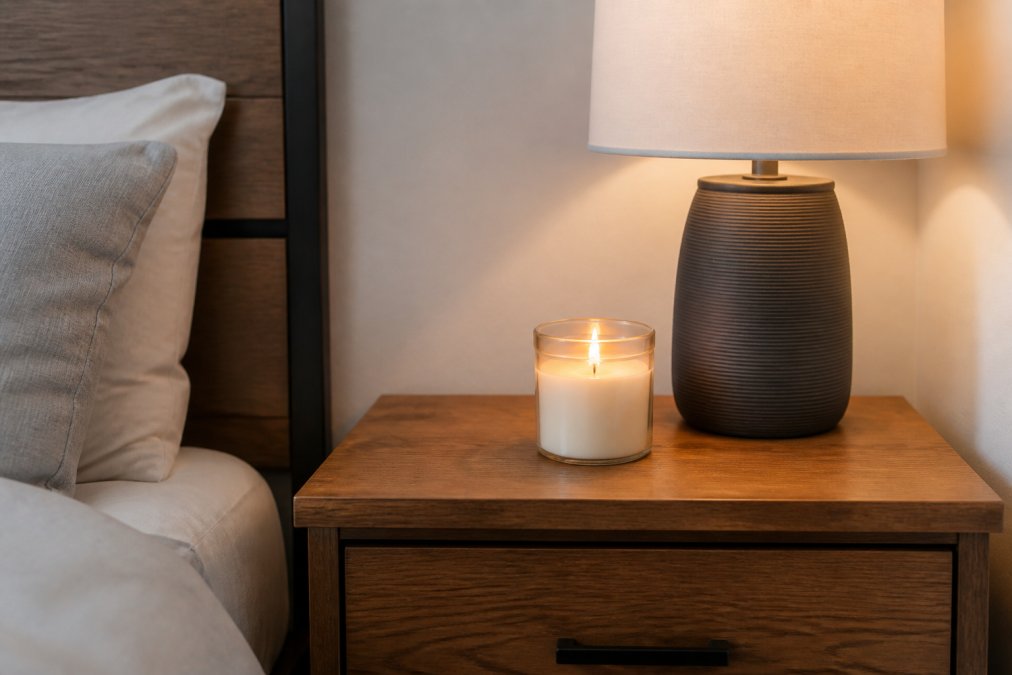
Choose Non Toxic Candles for Home Use
In small rooms, wax type, fragrance oils, and wick material directly affect air quality and what you breathe.
Paraffin wax releases more soot and volatile organic compounds (VOCs), which accumulate faster in small spaces. Soy wax and beeswax burn cleaner with less soot and are better for limited air circulation.
Scented candles with strong "scent throw" can overwhelm a small room and trigger headaches or respiratory irritation. Look for candles designed with moderate fragrance levels.
Paper-core wicks are safer than lead-core wicks. Quality candles disclose their materials clearly.
The best candles for small rooms use soy or beeswax blends, feature paper-core wicks, have moderate scent throw, and come from reputable makers who disclose ingredients. When you choose non toxic candles for home use, you're protecting both your air quality and your health.
Set Up Your Candle on a Fire-Safe Surface
Placement determines safety. A candle on the wrong surface can cause heat damage, fires, or thermal shock.
Always use a fire-safe surface like solid wood, glass, ceramic, stone, tile, or metal trivets. Never place candles on plastic, fabric, thin veneer, or near curtains, blinds, or hanging textiles.
The surface should be flat and level. Keep the candle at least 12 inches away from walls, shelves, and other objects.
Use a trivet or heat-resistant mat to protect surfaces and maintain proper clearance.
Avoid placing candles on windowsills. Drafts cause uneven burning and sunlight degrades wax and fragrance.
Wipe down your chosen spot before lighting to ensure it's clean and dry.
How to Prevent Candle Soot Buildup
Soot is the black residue from incomplete combustion. In small rooms with poor ventilation, it accumulates faster and creates visible stains.
Trim your wick to 1/4 inch before every burn, the single most effective way to prevent soot. Use a wick trimmer or nail clippers to cut straight across.
Remove wick trimmings from the wax pool. Debris in the melted wax causes smoking and soot.
Watch for wick mushrooming, a mushroom-shaped carbon buildup indicating the wick is too long or wax type isn't ideal. Trim it down or switch candle brands if it continues.
Tunneling increases soot when the candle burns down the middle but leaves a ring of solid wax. Prevent it by burning 2-3 hours on the first use to melt wax to the edges.
If you notice black marks on the ceiling or walls, trim the wick shorter or switch to a higher-quality candle.
Manage Ventilation and Air Currents
Small rooms need active ventilation when you burn candles to prevent oxygen depletion and combustion byproduct buildup.
10oz Frosted Black Jar Candle, Scented →
Crack a window 2-3 inches while the candle burns, or turn on a bathroom exhaust fan or ceiling fan on low speed.
Avoid drafts and air currents that blow directly on the candle. Drafts cause the flame to flicker and lean, which creates uneven burning and more soot. They also cool one side of the jar, potentially causing thermal shock. Position the candle away from:
- Open windows
- Ceiling fans
- HVAC vents
- Doorways with foot traffic
Air currents also push heat and smoke around the room unevenly. In a small bedroom, this means one corner gets hot while another stays cool. The flame bends toward the draft source, burning faster on that side.
If your small room has no windows or fans, consider opening a door to an adjacent room for air exchange. Even passive ventilation helps. The goal is to keep fresh air moving without creating drafts that affect the candle flame.
Monitor the flame. It should burn upright and steady. If it flickers or leans constantly, move the candle away from the air current source.
Follow Candle Burn Time Guidelines
Burn time rules are stricter in small rooms because oxygen depletion and combustion byproduct buildup happen on a compressed timeline. The key is understanding how room volume, not just clock time, determines safety.
Calculate your room's burn capacity. A standard 10oz jar candle consumes roughly 0.5 cubic feet of oxygen per hour of burn. To estimate safe burn duration:

- Measure your room's length, width, and height in feet.
- Multiply to get cubic feet. (Example: 10 ft × 8 ft × 8 ft = 640 cubic feet)
- Divide by 100 to get a rough "safe burn hours" baseline. (640 ÷ 100 = 6.4 hours total capacity)
- Reduce this number by 50% if the room is poorly ventilated or airtight. (6.4 × 0.5 = 3.2 hours safe capacity)
- Never burn a single candle for more than 4 hours continuously, regardless of room size.
For a typical small bedroom (around 400-600 cubic feet with a single window), this math suggests 2-3 hours of safe continuous burn time before air quality noticeably declines.
The first burn sets the pattern. Light the candle and let it burn for at least 2 hours on the first use. This allows the wax to melt completely to the jar edges, preventing tunneling. Skipping this step causes the candle to tunnel for its entire life, creating excess smoke and wasting wax. In a small room, a tunneling candle becomes uncomfortable far faster than a properly burned one.
Break burns into sessions. Instead of one 4-hour burn, split it into two 2-hour sessions with at least a 2-hour cool-down between them. During the cool-down, open a window or door to refresh the air. This approach:
- Prevents oxygen depletion
- Allows combustion byproducts (CO₂, water vapor, VOCs) to disperse
- Gives the jar time to cool, reducing thermal stress
- Lets your body reset and detect air-quality changes
Watch for the "stale air" threshold. Most people begin feeling discomfort, stuffiness, mild headache, or difficulty concentrating, after 3-4 hours of continuous candle burning in a small, poorly ventilated room.
Monitor Air Quality and Know When to Stop
Air quality in small rooms degrades faster than most people realize. Understanding what's actually happening chemically helps you recognize when to stop burning.
The three main air-quality threats from candles:
-
Oxygen depletion. A burning candle consumes oxygen and produces carbon dioxide. In a sealed small room, oxygen levels can drop from the normal 21% to 19-20% within 2-3 hours. Your body doesn't notice this immediately, but it affects cognitive function and increases fatigue.
-
Volatile organic compounds (VOCs). Paraffin wax candles release benzene, toluene, and other VOCs as they burn. Soy and beeswax release fewer VOCs, but all candles produce some. In a small room with poor air exchange, VOCs accumulate and cause headaches, throat irritation, and respiratory discomfort.
-
Carbon monoxide (CO). A properly burning candle produces minimal CO, but incomplete combustion (caused by a long wick, drafts, or insufficient oxygen) increases CO output. In a sealed small room, CO can reach unsafe levels (above 35 parts per million) within 4-6 hours of continuous burning.
Recognize these warning signs and what they mean:
| Warning Sign | What's Happening | Immediate Action |
|---|---|---|
| Headache or dizziness | Oxygen depletion, CO buildup, or VOC accumulation | Extinguish candle, open window, leave room for 10 minutes |
| Stuffy or stale-smelling air | CO₂ rising, oxygen falling, air stratification | Stop burning, crack window, ventilate for 15 minutes |
| Difficulty concentrating or fatigue | Oxygen below 19%, CO₂ above 1000 ppm | Extinguish immediately, rest in fresh air |
| Mild throat irritation or coughing | VOC concentration rising, possible incomplete combustion | Trim wick to 1/4 inch, extinguish if it continues |
| Visible smoke from the flame | Incomplete combustion, wick too long | Extinguish, trim wick, relight after 5 minutes |
| Flame flickering or leaning constantly | Drafts causing uneven combustion, excess soot production | Move candle away from draft source |
Conclusion
Understanding how to safely burn candles in small rooms comes down to five practices: choosing quality candles, placing them correctly, trimming wicks, managing ventilation, and respecting burn time limits. Small spaces demand more attention, but they're absolutely compatible with candles when you follow these rules.
Frequently Asked Questions
What is the 3-hour rule for candles?
The 3-hour rule recommends burning candles for no more than 3 consecutive hours before extinguishing and allowing the wax to cool. In small rooms, this rule is even more critical because the space fills with heat and combustion byproducts faster. Limiting burn time prevents excessive soot buildup, reduces oxygen depletion, and keeps indoor air quality from degrading. After each 3-hour session, let the candle rest for at least 2 hours before relighting.
How far away should candles be from walls in small rooms?
Keep candles at least 12 inches away from walls, curtains, and other flammable materials. In small rooms, this clearance is especially important because walls can trap heat and accelerate fire risk. Place your candle on a flat, heat-resistant surface like a trivet or ceramic tile in the center of a shelf or table, away from drafts. This distance also allows air to circulate around the candle, reducing soot concentration in one spot.
Do I have to open a window when I light a candle in a small room?
Opening a window is highly recommended when burning candles in small rooms. Small spaces lack natural air exchange, so volatile organic compounds (VOCs) and carbon monoxide can accumulate. Cracking a window 2-4 inches allows fresh air to enter and stale air to exit, maintaining oxygen levels and reducing indoor air pollution. If opening a window isn't possible, use a fan to direct air toward an open door or increase ventilation in other ways.
What are signs that a candle is creating poor air quality in my small room?
Watch for headaches, dizziness, or throat irritation shortly after lighting a candle, these signal air quality problems. Visible soot on the jar or walls, a strong smell that becomes overwhelming, or a stuffy feeling in the room also indicate issues. If you notice excessive smoke, mushrooming on the wick, or the candle burning too quickly, extinguish it immediately. These signs mean the candle is consuming oxygen faster than your small room can replenish it, or producing harmful byproducts.