
Table of Contents
- Hand Poured vs. Mass-Produced: What's the Real Difference?
- The Benefits of Soy Wax Candles for Clean Burning
- Why Artisan Candles Cost More (And Why It's Worth It)
- The Candle-Making Process: Pour Temperature, Curing, and Scent Throw
- How to Choose a High Quality Candle: A Practical Checklist
- Troubleshooting Common Candle Issues: Tunneling, Frosting, and More
- Conclusion: Make the Switch to Hand Poured Candles
- Frequently Asked Questions
Last Updated: September 9, 2026
Most candle lovers have been burned before: a gorgeous jar that smells like vanilla heaven in the store, only to tunnel down the middle and fizzle out in three burns. The difference comes down to how it was made. Hand poured candles are made in small batches with careful attention to ingredients and temperature, which is why they consistently outperform mass-produced counterparts. Below we'll show you what separates a quality candle from a pretty decoration and how to spot the difference.
The short answer: hand poured candles burn longer, smell stronger, and use cleaner ingredients than factory-made alternatives. Mass-produced candles are built for speed and shelf appeal, not performance.
Hand Poured vs. Mass-Produced: What's the Real Difference?
The core difference is control. When candles are poured by hand, the maker controls every variable: wax temperature, fragrance load, wick tension, and curing time. Factory lines prioritize throughput, adding fragrance oils at lower percentages to cut costs and shipping candles before they've properly cured.
That lack of control shows up in the burn. A candle that hasn't cured long enough has a weaker scent throw, because the fragrance hasn't fully bonded with the wax. Mass-produced candles also frequently use paraffin wax, a petroleum byproduct that can release more soot into your air (the EPA).
Handcrafted candles, by contrast, are often made with natural ingredients like soy wax and cotton wicks that burn cleaner. Each small-batch pour gets individual attention, from wick centering to quality control, so you're far less likely to get a candle that tunnels or drowns its wick.
The Benefits of Soy Wax Candles for Clean Burning
The Soot Argument: It's About Molecular Structure
Paraffin is a petroleum byproduct of longer-chain hydrocarbons. When those chains burn incompletely, more readily in a fast, hot flame, they release unburned carbon particles, seen as black soot. Soy wax is composed of shorter-chain fatty acids that break down more completely at lower temperatures, producing significantly less visible particulate matter.
In home testing, a soy candle leaves a faint gray residue on a white dish held above the flame, while paraffin leaves a distinct black mark. This isn't 'cleanliness' as a marketing term; it's the combustion efficiency of different hydrocarbon structures.
The Cooler Burn: Why It Changes Everything
Soy wax has a lower melting point, typically 115°F to 125°F, compared to paraffin's 130°F to 150°F range (candles.org). This drives three measurable outcomes:
-
Longer Burn Time: A cooler-burning wax consumes itself more slowly. All else equal, a 10oz soy candle often burns 30-50% longer than the same size paraffin candle.
-
Better Scent Release: Fragrance oils vaporize at specific temperatures. A cooler, stable melt pool releases them steadily over hours; a hotter paraffin pool can 'flash off' top notes, leaving a strong scent for the first hour and a faint one by hour three.
-
Safer Container Temperature: The exterior of a glass jar holding a soy candle runs noticeably cooler than one holding paraffin, reducing burn risk and making soy a better choice for smaller spaces or homes with pets.
The 'Clean Burn' Caveat: It's Not Just the Wax
The wax is only half the equation. A soy candle with a synthetic fragrance load and a lead-core wick still releases unwanted compounds. The 'clean burn' benefit only fully materializes when three conditions are met:
- Wax: 100% soy or a soy-coconut blend, not a 'soy blend' that is 30% soy and 70% paraffin (a common industry loophole).
- Wick: Cotton or wood, never one with a metal core (lead was banned in wicks in the U.S. in 2003, but zinc and tin cores are still used and can produce trace heavy-metal emissions) (cpsc.gov).
- Fragrance: Phthalate-free oils. Phthalates are plasticizers used to make scents linger in the wax, but they are also known endocrine disruptors. The term 'phthalate-free' on a label means the maker chose a more expensive, often naturally-derived fragrance base.
The Sustainability Angle, Quantified
Soy is a renewable resource grown domestically in the U.S., primarily in the Midwest. Paraffin, by contrast, is a byproduct of crude oil refining, its supply and price are tied to the fossil fuel market. Choosing soy supports a domestic agricultural supply chain rather than a petrochemical one.
That said, soy isn't perfect. Most soy wax is hydrogenated, and some growers use conventional farming practices. If that matters to you, look for candles made with certified non-GMO soy wax or sourced from farms using sustainable practices.
Why Artisan Candles Cost More (And Why It's Worth It)
Why does a hand poured candle cost more? The answer is in materials and time. Premium soy wax, phthalate-free fragrance oils, and cotton or wood wicks cost more than paraffin and synthetic blends. Then factor in the labor of small-batch production, where each jar is poured, centered, and inspected by hand.
The price difference also reflects curing. Quality candles rest for days or weeks after pouring so the fragrance fully binds to the wax, patience impossible on a factory line. You're paying for a candle that performs, not one that just looks good on a shelf.
Consider value per burn. A candle that burns evenly and lasts 50+ hours delivers more per dollar than a cheap candle that tunnels and dies in 20. For a 10oz jar candle at $14.99, like the 10oz Frosted Jar Candle, Scented, you're getting consistent ambience and a stronger scent than a bargain option that burns out fast.
| Candle Type | Wax Source | Typical Scent Throw | Burn Evenness | Price Range |
|---|---|---|---|---|
| Mass-Produced | Paraffin blends | Weak to moderate | Often tunnels | $5-$15 |
| Hand-Poured Soy | Natural soy wax | Strong, consistent | Even with proper care | $15-$25 |
| Custom/Personalized | Natural soy wax | Strong, customizable | Even with proper care | $20-$100+ |
The Candle-Making Process: Pour Temperature, Curing, and Scent Throw
Understanding the process explains why hand poured candles perform better. It starts with pour temperature. Soy wax needs to be heated to the right range, typically 120-180°F, before fragrance oil is added. Pour too hot and the fragrance burns off; pour too cool and it won't bind properly.
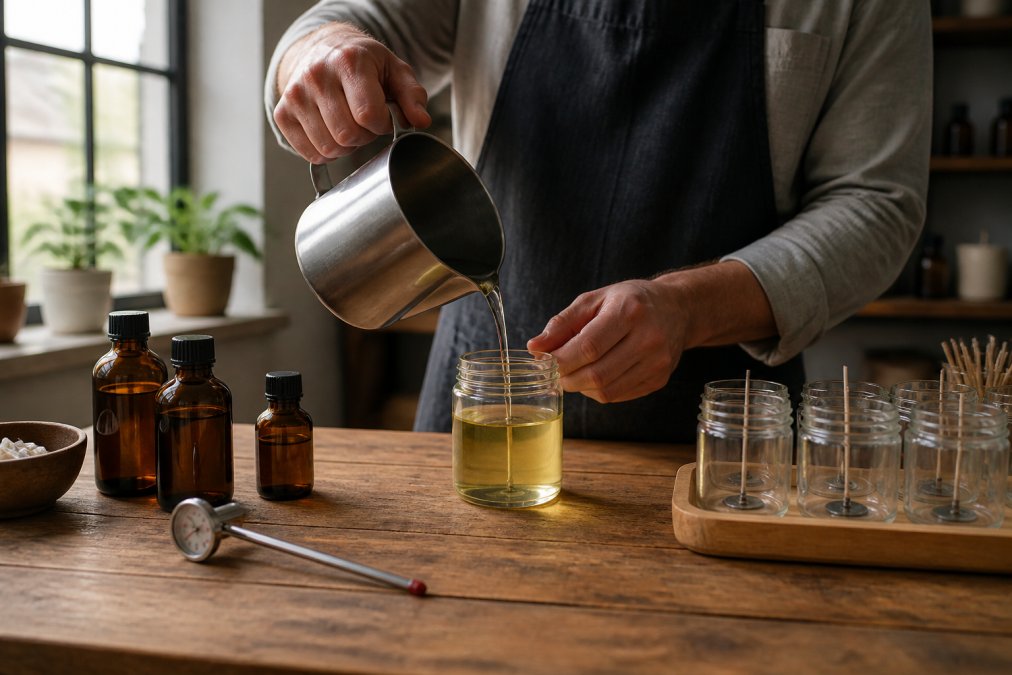
After pouring comes curing, a waiting period of usually 2-7 days where the candle rests so fragrance molecules fully integrate with the wax. A candle that skips this step will have a weak cold throw and a disappointing hot throw once lit.
Wick selection matters too. Cotton wicks are most common for even burns, while wood wicks add a crackling ambience. The wick must be sized to the jar's diameter; too small and you get tunneling, too large and you get soot. Proper wick centering ensures an even melt pool that reaches the edges on the first burn.
How to Choose a High Quality Candle: A Practical Checklist
Here is the buying framework we use, organized by what you can check before you buy and what you can only verify after the first burn.
Pre-Purchase Checks: What the Label Should Tell You
1. Wax Transparency Look for the exact wax type. '100% soy wax' or 'coconut-soy blend' are specific claims. 'Soy blend' or 'natural wax blend' often means the majority is paraffin, which is cheaper and helps candles hold their shape in warm warehouses. If a label doesn't specify the percentage, assume it's mostly paraffin.
2. Fragrance Load Percentage This is the single most important number on a candle label, and most brands hide it. Fragrance load is the percentage of fragrance oil by weight in the wax. Here's what the numbers mean:
- 3-5%: Typical for mass-market candles. You'll smell it in the store (cold throw) but it will fade quickly once lit.
- 6-8%: A decent mid-range candle. Noticeable hot throw, but may not fill a large room.
- 9-12%: The sweet spot for hand-poured candles. This is where you get the 'scent fills the room within 10 minutes' experience.
3. Phthalate-Free Claim This should be printed directly on the label or stated clearly in the product description. If it's absent, the fragrance oils almost certainly contain phthalates, which are used to make synthetic scents 'stick' to the wax. They're also linked to hormonal disruption. This is a non-negotiable for anyone with allergies, asthma, or who burns candles daily.
4. Wick Type Cotton and wood are the quality standards. Cotton wicks should be braided, not twisted, as braiding creates more even capillary action. Wood wicks should be a single piece of sustainably sourced wood, not a composite. Avoid any wick described as 'cored', that means it has a metal wire inside.
5. Curing Time Disclosure Quality makers cure candles for a period after pouring, allowing fragrance molecules to fully bond with the wax. A candle poured and shipped too quickly will have a weak scent throw, regardless of fragrance load.
The Chemistry of Scent Throw: What 'Strong' Actually Means
There are two distinct phases of scent throw:
-
Cold Throw: The scent you smell when the candle is unlit, coming from fragrance oils that migrated to the surface during curing. A strong cold throw means proper curing and high fragrance load. But cold throw is deceptive, it tells you the fragrance is present, not how it will perform when heated.
-
Hot Throw: The scent released when the flame heats the melt pool. Fragrance oils blend top notes (light, volatile molecules like citrus), middle notes (floral or herbal), and base notes (heavy, persistent molecules like vanilla or sandalwood), each evaporating at a different temperature. A well-formulated candle releases all three in sequence, creating a complex, evolving scent. A cheap candle often uses only top notes, which is why it smells strong for the first 15 minutes and then disappears.
Post-Purchase Verification: The First Burn Test
You can't verify a candle's quality until you light it. Here's what to check on the first burn:
-
Melt Pool Timing: A properly wicked candle should achieve a full melt pool (wax melted edge-to-edge) within a reasonable timeframe. If it takes too long, the wick might be too small, leading to tunneling; if it's too fast, the wick might be too large, causing soot.
-
Soot on the Jar: Within the first hour, check the rim. A clean burn leaves no black residue. Any soot can indicate the wick is too large or the wax is paraffin-heavy.
-
Scent Persistence: After 2 hours of burning, leave the room for 10 minutes, then re-enter. A quality candle often leaves a lingering scent that's noticeable; a weak candle may have dissipated.
The Price-Per-Burn Calculation
Instead of comparing price per ounce, compare price per burn hour: a $10 mass-market candle with a 20-hour burn time costs $0.50 per hour, while a $20 hand-poured candle with a 50-hour burn time costs $0.40 per hour. The hand-poured candle is cheaper per hour of actual use and delivers a stronger scent during those hours.
Red Flags to Avoid
- 'Premium' or 'Luxury' with no ingredient specifics: These words are meaningless without wax type and fragrance load percentages.
- No burn time listed: A quality maker knows their candle burns for a specific range and will publish it.
- Glass jars with narrow necks: These restrict the melt pool and cause tunneling. Look for straight-sided jars or wide-mouth containers.
- 'Hand-poured' without small-batch language: If a brand pours thousands of units a day, even 'hand-poured' means a production line, not artisan craftsmanship. Look for 'small batch' or 'made in batches of [number].'
Troubleshooting Common Candle Issues: Tunneling, Frosting, and More
Even quality candles can have issues if you don't burn them correctly. The most common problem is tunneling, where the candle burns straight down the middle, wasting wax on the sides. This happens when the first burn doesn't last long enough to create a full melt pool. Always burn your candle for 2-3 hours on the first lighting, or until the wax melts edge to edge.
Frosting and spotting are cosmetic issues common to soy wax. Frosting appears as white, crystalline patches on the surface, while spotting shows as small white dots. These are natural characteristics of soy wax, not defects. They don't affect the burn or scent.
Another common issue is a wick that "mushrooms" or produces soot. This usually means the wick is too large for the jar, or you're burning the candle too long at a stretch. Trim the wick to 1/4 inch before each burn and limit burn sessions to 3-4 hours.
Conclusion: Make the Switch to Hand Poured Candles
The switch from mass-produced to hand poured candles often means you get a cleaner burn, a stronger scent, and a candle that lasts longer, all while supporting small-batch craftsmanship.
At Carbondale Candle, we pour every candle by hand with premium soy wax and phthalate-free fragrance oils. From our 10oz Frosted Black Jar Candle, Scented to fully customizable Memorial Candles and the impressive 90oz three-wick custom candle, there's an option for every space and every occasion. Get Lit With Us and experience the difference that handcrafted quality makes in your home.


Frequently Asked Questions
Are hand poured candles better than mass-produced ones?
Yes, for several reasons. Hand poured candles are made in small batches, which allows for quality control at every step. They typically use natural ingredients like soy wax and phthalate-free fragrance oils, resulting in a cleaner, more even burn. Mass-produced candles often prioritize speed over quality, which can lead to poor scent throw, tunneling, and the use of paraffin wax, a petroleum byproduct that releases more soot when burned. The attention to detail in a hand poured candle directly impacts its performance and safety in your home.
What does the term 'hand poured' actually mean for candle quality?
Hand poured means the wax is melted and poured into containers manually, not by an assembly line machine. This process matters because it allows the maker to control the pour temperature, which prevents issues like frosting and poor adhesion to the jar. It also ensures each wick is centered correctly for an even burn. Small-batch production means each candle gets individual attention, from the mixing of fragrance oils to the curing process, which results in a stronger hot throw and a more consistent product than a candle made by an automated system.
What is the healthiest type of candle to burn?
Candles made from natural, clean-burning waxes like soy or coconut are generally the healthiest choice. Look for candles with 100% cotton or wood wicks and fragrance oils that are phthalate-free. Paraffin wax, which is common in mass-produced candles, can release more soot when burned. A high quality hand poured candle made with soy wax and non-toxic ingredients will produce significantly less soot and fewer airborne chemicals, making it a safer option for your indoor air, especially for those with allergies or sensitivities.
How does the candle-making process affect scent throw?
The process is critical to scent throw. The temperature at which fragrance oil is added to the wax matters; if the wax is too hot, the scent can burn off, and if it's too cool, it won't bind properly. After pouring, candles must cure for a period, allowing the fragrance to fully integrate with the wax. Hand poured candles typically undergo this proper curing process, which is why they often have a stronger and more accurate scent throw than mass-produced versions that are rushed to market. This attention to detail ensures you smell the candle's true fragrance when lit.